Built to Last
Why Retaining Walls Fail
Erosion eating a hillside, a slope that keeps shifting after every heavy rain, a wall that was built years ago and is now leaning or crumbling. Georgia's summer rainfall is heavy and persistent. The clay soil that covers most of Newton County absorbs water slowly and holds it a long time. When that saturated soil is on a slope, it moves. Without proper drainage behind a retaining wall, hydrostatic pressure builds up and pushes the face outward until the wall fails.
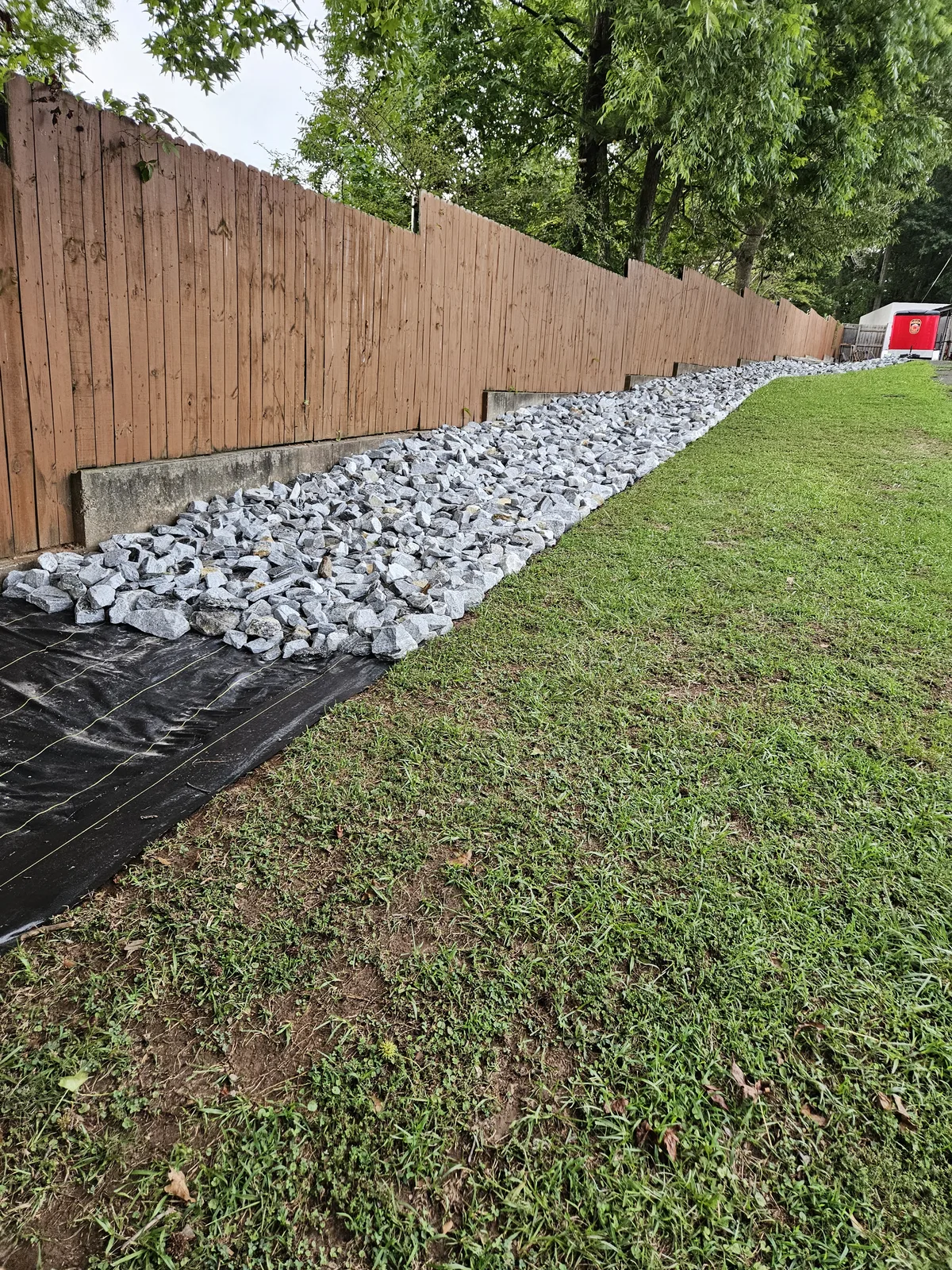
Most retaining wall failures come down to two things. First, no drainage aggregate behind the wall to relieve water pressure. Water has to go somewhere, and if there is no gravel backfill and drainage outlet, it pushes directly against the wall face. Second, no footing. A wall set on top of the soil without excavating to a stable base will shift and lean as the ground moves with the seasons. Both are shortcuts that cost significantly more to fix later than to do right the first time.
At Liba, every wall starts with a walk of the property to understand the slope, what is above the wall, how water drains across the hillside, and what material suits the application and the owner's style. We excavate the footing, set proper drainage aggregate behind the wall face, and build to the height and setback that the load and slope require. For taller slopes, we build tiered walls with flat benches between levels, which distributes the load and creates usable yard space at the same time.
We work with concrete block, natural stone, and timber depending on the project. Concrete block is cost-effective for functional walls. Natural stone is the choice for decorative applications where appearance matters as much as function. Timber is an option for lower walls with a more traditional look. We give you the options and the honest trade-offs for each, then let you decide.
Georgia clay swells when saturated and contracts when it dries out. That cycle of expansion and contraction puts lateral pressure on retaining walls that were not built with proper drainage behind them. Most wall failures we see in Newton County are not a materials problem. They are a drainage problem. Water built up behind the wall with nowhere to go and pushed it forward over several seasons. Every wall we build gets a compacted gravel drainage bed behind it and weep holes or drain pipe to relieve that pressure before it becomes a structural issue.